

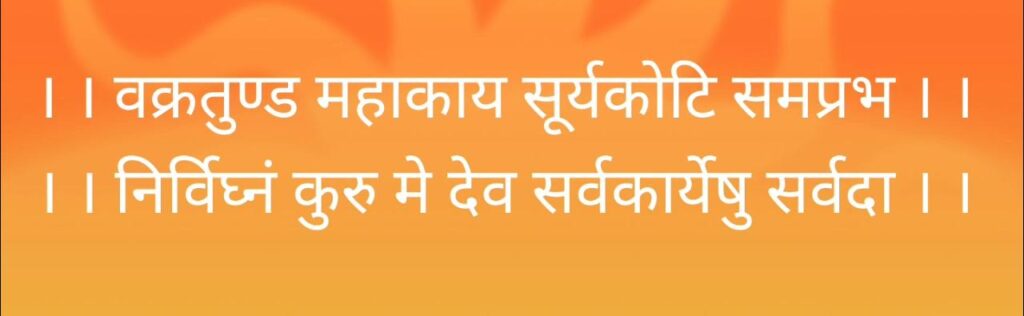
वक्रतुण्ड महाकाय सूर्यकोटि समप्रभः।
निर्विघ्नं कुरु मे देव सर्वकार्येषु सर्वदा॥
Vakratuṇḍa mahākāya sūryakoṭi samaprabhaḥ,
Nirvighnaṁ kuru me deva sarvakāryeṣu sarvadā.
Meaning in Brief: “Oh, Lord Ganesha, with a curved trunk and a grand, majestic form, whose radiance is akin to millions of suns, I beseech you to remove all obstacles and ensure success in all my endeavors.”
in simple words “O Lord with the curved trunk, massive body, and radiance equal to a zillion suns,
please remove obstacles from all my tasks, always, for me.”
Word by Word Meaning of Shloka Vakratuṇḍa mahākāya
वक्रतुण्ड (Vakratunda)
- Vakra = curved
- Tunda = trunk
: “Curved trunk”
महाकाय (Mahākāya)
- Mahā = great / huge
- Kāya = body
: “Great-body”
सूर्यकोटि (Sūrya-koṭi)
- Sūrya = sun
- Koṭi = ten million
: “Millions of Suns”
समप्रभः (Samaprabhaḥ)
- Sama = equal
- Prabhā = radiance / brilliance
: “With brilliance equal to” (millions of suns)
निर्विघ्नं (Nirvighnam)
- Nir- = without
- Vighna = obstacles
: “Without obstacles” or “Obstacle-free”
कुरु (Kuru)
- Kuru = do / make
: “Please make” (Imperative form)
मे (Me)
- Me = for me
: “For me”
देव (Deva)
- Deva = god
: “O Lord” (Addressing Ganesha)
सर्वकार्येषु (Sarvakāryeṣu)
- Sarva = all
- Kāryeṣu = tasks / undertakings
: “In all my tasks”
सर्वदा (Sarvadā)
- Sarvadā = always
: “At all times”
About The Shloka
The “Vakratunda Mahakaya” shloka is one of the most revered and widely recited mantras dedicated to Lord Ganesha, the deity known as the remover of obstacles and the lord of beginnings.
In Sanatan Dharma (Hinduism), it is customary to begin any ritual, prayer, or auspicious activity by invoking Lord Ganesha. He is regarded as the Adideva (first deity) to be worshipped before any other, as prescribed by dharmic tradition.
The “Vakratunda Mahakaya” shloka serves as a dhyana mantra — a meditative verse used to focus the mind on the form and attributes of the deity. Its recitation at the beginning of any endeavor is meant to seek divine blessings and eliminate potential difficulties.
The qualities described in the shloka are symbolic:
- Vakratunda (Curved Trunk): Signifies flexibility and adaptability.
- Mahakaya (Great Body): Represents the vastness and cosmic nature of Ganesha.
- Suryakoti Samaprabha (Radiance of a crore suns): Symbolizes immense spiritual light and wisdom.
- Nirvighnam (Without obstacles): The core blessing sought from Ganesha.
- Sarvakaryeshu Sarvada (In all undertakings, always): Indicates the comprehensive and constant need for divine assistance.
Video
Ideal Time to Recite the “Vakratunda Mahakaya” Shloka
Recommended Times for Recitation
- Early Morning (Brahma Muhūrta or Sunrise)
The most auspicious time is during the Brahma Muhūrta (approximately 4:00–4:30 AM), before dawn. This time is traditionally sacred for spiritual practice. Chanting during sunrise is also highly recommended to align with new beginnings and fresh energy. - Before Important Tasks or Rituals
Regardless of the exact time, it is customary to chant this shloka before starting major undertakings—such as studies, ceremonies, business activities, or travel—to invoke Ganesha’s blessings for success and obstacle removal. - During Ganesh Festivals (e.g., Ganesh Chaturthi)
Special emphasis is placed on reciting this shloka during Ganesh Chaturthi and other Ganesha-related observances when collective devotional energy is strongest
| Recommended Time | Why It’s Considered Ideal |
|---|---|
| Brahma Muhūrta (4:00–5:30 AM) | Quiet, spiritually potent time; conducive to deep focus |
| Sunrise | Symbolic of new beginnings and clarity |
| Before significant tasks/pujas | To seek divine support and remove obstacles beforehand |
| During Ganesha festivals | Amplifies collective devotional power and connection |
Key Insight
- The most traditional and spiritually potent time is early morning (Brahma Muhūrta) or at sunrise, when mental and environmental energies are considered most favorable.
- Nonetheless, the sincerity and intention behind the chant matter more than the exact time—you’re welcome to recite it any time of day, as long as it’s done with focus and reverence